Foraging: Sliding Doors
The company where AI writes 60% of the code is the one that would not let AI answer the front door.

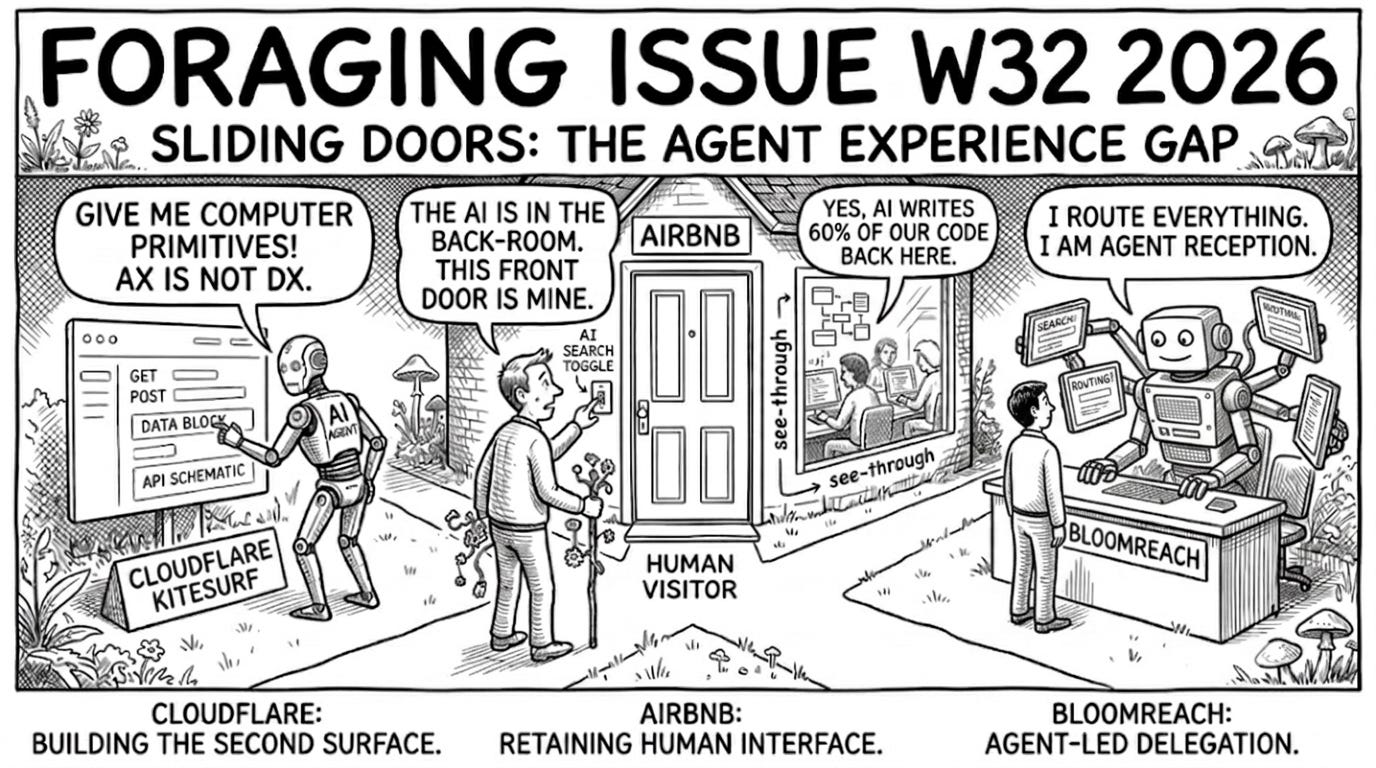
On Friday, two companies shipped versions of the same idea a few hours apart and disagreed about who it was for.
Cloudflare released Kitesurf, a browser built with no human in mind. It runs on Workers, renders Wikipedia and Hacker News, and passes north of 215,000 web platform tests. It has no themes and no extensions, because the thing using it does not have eyes. The pitch is that it is more efficient in CPU and memory than Chromium for the things agents actually do, screenshots and HTML extraction. They built it in twelve weeks.
Airbnb spent the same morning proving it had no reason to be timid. In a year of numbers on what AI had done to its own development, Brian Chesky said: “Today, we’re building, testing, and iterating faster than we could just a year ago.” AI now writes 60% of the company’s new code, and support costs fell as automated resolution climbed.
Then Airbnb announced its new AI search. It is a toggle. The traditional filters stay on by default.
I have been arguing for the agent experience gap since April. It was clear in my mind that we would need agent experiences. It’s really good to see it becoming reality so fast. There are three gravel paths emerging from this week’s updates. What remains to be seen is which one becomes a highway: whether agents get their own room, their own door into ours, or get to answer the door themselves.
AX Is Not DX
Agents don’t care for the experiences, the pixels. They don’t care for FAQs that are stuffed for GEO, the new keyword stuffing, they don’t care for sitemaps. They carry a ton of context and want the best information to answer that, fast. They try to predict what happens next and want that information. A human’s needs are added weight for an agent.
Nicholas Charriere put it plainly in July, reacting to Fly.io: “build for agents, AX is not DX. Give agents good computer primitives.” He had been bearish on Fly and switched, on this point alone.
Cloudflare is a great example of a company taking this literally. They built Kitesurf as a new browser. They took the twelve-week bet because this is a different workload, and patching existing solutions is a dead end.
I should be transparent that this is the problem space I work on at Typeface, so I have skin in this argument. It is also why the twelve weeks reads as significant to me rather than as a press-release flourish. Retrofitting a human surface for agents is the expensive path. Building the second surface is often the cheap one, and almost nobody budgets for it because it does not look like a feature.
The Default Is the Judgement
Airbnb could have made AI search the default. With those numbers behind it, nobody would have called that reckless. Choosing the toggle is a judgement about who the interface belongs to. The judgement is that it belongs to the human.
Read the Airbnb design closely and it is careful in a specific way. Natural language replaces the filters if you ask for it. Results come back with AI-generated titles, presented conversationally. Personalized highlights show up on the listing pages.
All of it sits behind a switch the user throws, and the person who never throws it never sees any of it. The company built a second surface and declined to make it the front door.
Shopify’s quarter says the same thing with harder numbers. On the Q2 call, traffic and orders arriving through AI tripled year over year while traditional search kept growing rather than shrinking, and 75% of AI-attributed purchases came from outside the top 100 categories. Shopify’s president called AI “a complement to search, rather than a substitute for it.”
That last figure is the one worth sitting with. Three quarters of AI-attributed purchases happened outside the categories that dominate the storefront. The agent is reaching things the filters were never good at surfacing: the oddly specific request, the item you would have needed to know the name of already. Two surfaces are finding two different kinds of demand. Collapsing them into one would cost you the second.
I wrote last week that the cheaper the output gets, the more the human job becomes deciding what is true. This is the interface version of that. The more the agent handles, the rarer and higher-stakes the human’s own sessions become, and the worse it serves that human to hand them a surface shaped for a machine that is no longer the one sitting there.
The Box That Eats Everything
Then there is the other bet, and the difference is one of scope.
Two days before all of this, Raj De Datta, who co-founded Bloomreach and runs it, posted the opposite conviction: “the search box has always been the most important user intent input mechanism, now it becomes an agent for everything.” Bloomreach shipped it the same day. One search bar absorbs keyword search, conversational shopping, and customer service, with their Loomi platform classifying intent in real time and routing each request without the shopper changing pages.
There is no second room and no toggle. The agent takes over reception.
For commerce specifically, that may be the right call, and the Shopify data hints at why. A shopper arriving at a search box has already delegated. They want the thing, they do not want to operate the machinery, and routing is invisible labor they should never have to see. Compare that to a host onboarding a property on Airbnb, or an engineer approving an agent’s pull request. Those people are deciding, and a surface that quietly routes on their behalf takes away the thing they came for.
The split turns on whether the person on the other side is choosing or delegating, and has little to do with how advanced the company is. Choosing needs a human surface with the machinery visible. Delegating needs the machinery gone. Most enterprise products contain both kinds of moment and ship one interface for both, which is the actual gap.
I run into my own version of this every morning. The knowledge base I built for my reading has two faces over one body of material. There is a page I read, and there is a folder of plain markdown that the agents read and write, and the markdown is the source of truth.
I did not plan that. It emerged because the page kept being the wrong shape for anything automated, and the files kept being unpleasant to read on a phone. Two surfaces, one substrate, and it is the same seam Cloudflare and Airbnb spent this week drawing in public.
It also keeps me honest. This week the system handed me a statistic about AI tool sprawl, attributed to Workday. The finding was BCG’s. Someone upstream had merged two studies, and I only caught it by opening the source.
The Odd Find
Swatch had a heavily promoted launch overwhelmed by pictures of a product that did not exist. AI-generated images of the watch spread faster than the official campaign, and the fabricated versions were more desirable than the real one. The marketing team was out-imagined by strangers with an image model, and by the time the actual product arrived, the audience had already decided what it looked like.
Every brand has spent two years worrying about AI-generated content on the inside, the copy, the assets, the workflow. This one came from the outside in.
Cloudflare gave the agent its own room. Airbnb gave it a door with a handle only the human can turn. Bloomreach let it answer reception. All three shipped inside a week, and none of them are hedging, because each one knows something specific about who is on the other side.
The question worth asking about your own product is not whether agents are coming to it. It is which of your users are still choosing, and whether you would recognize them if they stopped.