Foraging: Ground Control
The cheaper AI makes the work, the more valuable the human job becomes: deciding what's true and what's worth building.

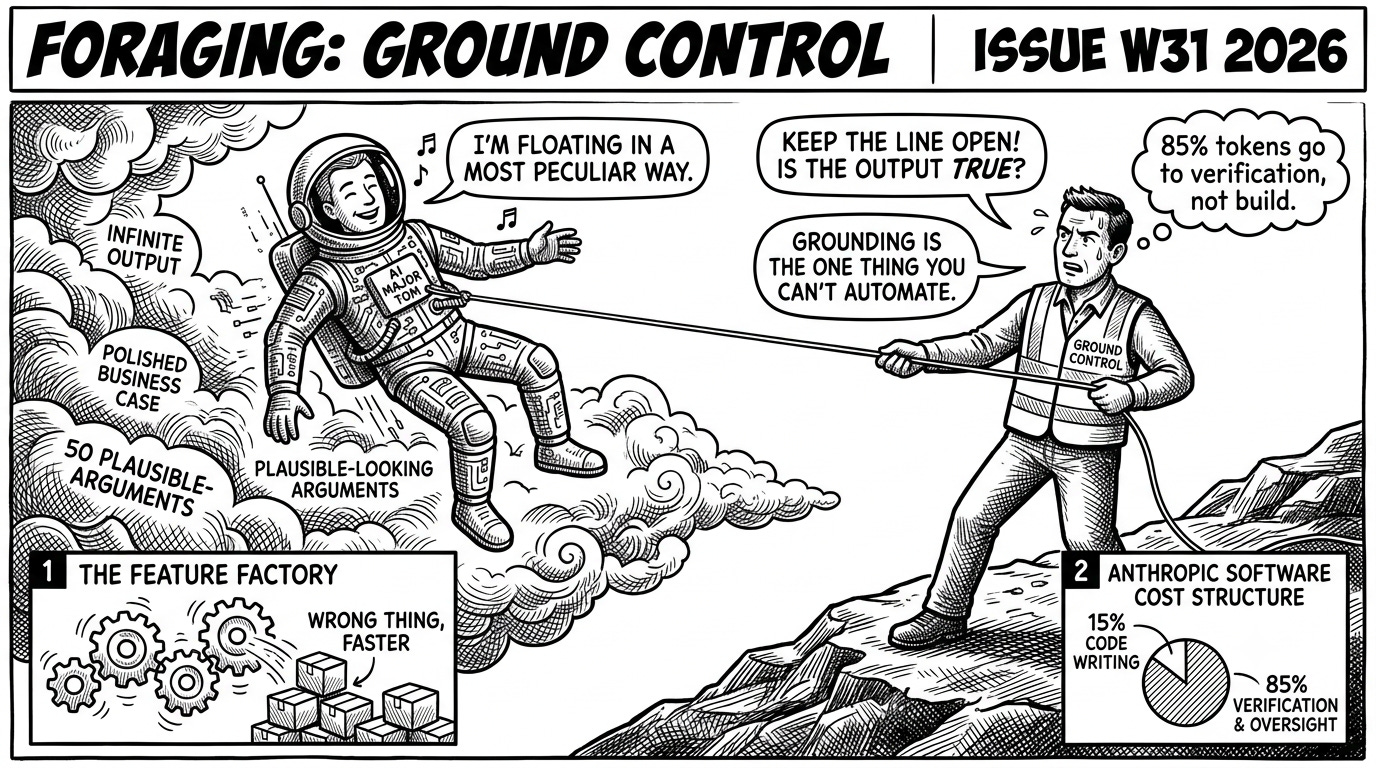
Every morning a system I built reads my week’s reading and hands me back drafts. It scans the feeds, pulls the summaries, notices when three unrelated people are circling the same idea, and writes the first version of the connection. The reading is free now. I used to spend the front of my day gathering. That part is gone.
The part that is not gone is the hour after. The easy version is fact-checking. The system hands me a stat it half-invented, a quote it lightly reshaped, a clean number like “36 brands out of the top 100” attributed to a report that never contained it. The draft reads fluent and turns out wrong, and I only catch it because I open the source and read it myself.
Catching a bad stat is the floor. The harder part is that the whole read can be off: a “convergence” that is two people saying different things in the same words, or a real pattern that points somewhere I do not believe. The gathering and the drafting are automated now. Judgment is not. The system brings me the signals, and I supply the point of view, usually by reframing the whole piece around a conviction the machine never had. That is the part that stayed mine.
The Bill Comes Due at Verification
Here is what I believe, and it took me a while to say it plainly: AI relocated the cost of building software. It went to a place most orgs are not watching.
None of this is a case against AI. I build with it every day and I want more of it, aimed at bigger problems. This is the bullish read: the machine got so good that the scarce work moved up a level, to deciding what is true and what is worth doing. That is a better job than the one it replaced.
Gergely Orosz got inside Anthropic and came back with the number that proves it. In How building software is changing at Anthropic, he reports that engineers run 3 to 10 agents in parallel with no token budgets and no usage tracking, and that in one real production migration roughly 85 percent of the tokens went to verification and only 15 percent to writing the code. The build is the cheap part. The checking is the expensive part. That single ratio is the cost structure of software turning inside out.
The practitioners already knew the shape of it. Addy Osmani has been arguing for months that the real craft is building the loop that prompts your agents, and his warning is the one that stuck with me: automating the doing makes oversight harder, because a loop running unattended is a loop making mistakes unattended. His line for where the truth lives is “the agent forgets, the repo doesn’t.” Anatoli Kopadze, restating the same idea for a general audience, lands the metric that matters: cost per accepted change, and below roughly a 50 percent accept rate the loop costs you more than it saves. The model that did the work is too generous a grader of its own work.
Stack those and the picture is unambiguous. Generation became elastic. You can spin up ten agents for the price of a coffee. Verification stayed inelastic, because it is one human deciding whether the output is actually true, and you can’t put that human inside the loop without the loop grading its own homework. So the more the machine produces, the larger the share of the whole thing lives in the part you can’t automate. The short version: the real work is grounding, and writing the loop is the easy half.
A Faster Feature Factory Is Still a Feature Factory
The engineers found this in tokens. Marty Cagan found the same wall in product orgs, and he found it earlier and angrier.
The bottleneck was never delivery speed, which is why Cagan’s diagnosis of the AI Productivity Paradox lands: teams ship more, faster, and report that none of it moves the numbers that matter. His sentence for it is the one I keep quoting to people: “A faster Feature Factory is still just a Feature Factory.” Speeding up the build without changing how you decide what to build produces more of the wrong thing, faster. And there is a nastier second-order effect. Weak ideas now arrive, in his words, “with a polished business case and 50 plausible-looking arguments,” so the scarce resource is judgment: the ability to tell a good idea from a well-dressed bad one.
The individual-level version showed up in another Cagan post that same stretch. He shared David Brooks’ Atlantic essay on who thrives in the AI age, and Brooks’ claim rhymes with Cagan’s: what separates people is their relationship to mental effort. “When intelligence is plentiful, volition is valuable.” The people who pull ahead wrestle with the machine to sharpen their own thinking; the ones Brooks calls cognitive misers use it to stop thinking and quietly atrophy. The line from the discussion that belongs on a wall: AI makes output cheaper, but it does not make judgment any less risky.
This is Orosz’s 85 percent told without a token metric. Cheap generation raises the value of judgment, because the world is now full of confident, fluent, well-argued output and someone still has to decide which of it is true. I should be transparent: this is the problem space I work on, content infrastructure at Typeface. The moment producing a draft costs nothing, the whole job becomes deciding which draft is right, on brand, and worth sending.
So the gap is closable, and you close it with contact. You can’t ground an enterprise product from a dashboard or a demo, so the strongest AI teams are rebuilding the forward-deployed engineer as the answer: a person inside the customer’s real workflow, with their people and their processes, watching how the work happens and feeding it back into the system. The forward-deployed engineer is grounding written as a job description, a role you staff on purpose rather than an afterthought.
And that is only the customer-facing version. Engineers staff the same instinct as a verification function that reads the code before it ships. Every gap in this piece has its own version. Wherever the machine floods output, someone has to own the grounding. That is how cheap generation turns into work you can ship. The factory got faster. The deciding got closer to the customer.
The Map Is Not the Train
The sharpest version of the week came from a turnaround. Nobody in it was talking about AI.
What I have believed for a long time, and what this piece put a blade on, is that the dangerous failure is the system that keeps running, green lights on, while it quietly loses contact with reality. The loud breakage is the easy case. Kaz Nejatian took over Opendoor months from bankruptcy, and in Gokul Rajaram’s write-up of his playbook the company now buys 6 to 7 times more homes per week than a year ago at less than half the OpEx. His seventh rule is the one that fused the whole week for me: “The Map Is Not The Train. Dashboards are a first derivative of the facts. Build models on models and you drift from reality until you go bankrupt.” So he talks to customers weekly and reads the raw database himself. He also found that 11 people once sat between a customer typing their address and getting an offer, and that removing them raised demand.
That is Osmani’s warning wearing a suit. A dashboard is a loop reading a loop. Carlos Perez, writing about why self-improving systems fail, gives the general form: build the whole apparatus, the metrics and the meta-metrics and the reviews of the reviews, and if every loop reads its numbers from the same drifting reports, then “every loop watches another loop, and no loop touches the ground.” It fails exactly as a single loop fails, only later and more expensively and with more green lights on the way down. His conclusion is the sentence this entire edition is built around: “The durable axis was never loops versus graphs. It is ungrounded versus grounded.”
Four people. An engineering leader counting tokens, a product thinker counting features, a columnist counting cognitive habits, an operator reading a raw database at 9am. None of them cite each other. All of them are describing one thing. When the machine can generate infinitely, the scarce and un-automatable act is the one that touches the ground: a person deciding, against reality rather than against another report, whether the output is true. The generating is Major Tom, floating and beautiful and out of contact. Your job is Ground Control.
The Odd Find
The most successful influencer Hyundai ever hired does not exist.
To launch the Kona in Morocco, Hyundai ran the whole campaign through Kenza Layli, an AI-generated Moroccan influencer who had already won the first Miss AI pageant. She fronted the YouTube ad, posted to social, and worked the bottom of the funnel as a chatbot talking to buyers in up to eight languages, her content localized in real time. Hyundai called it the best-performing influencer launch in its history, with more than 2,000 conversations running at once and a claimed 20x return. That number is brand-reported, so discount it accordingly. The part that holds up without the asterisk: the salesperson closing those deals was rendered, fluent in eight languages, and awake in all of them at once.
Every source this stretch was about staying in contact: with the code, with the customer, with the raw database, with what is actually true. There is one more kind of contact the machines quietly charge you for. Fiona Fung, who runs Claude Code engineering at Anthropic, said her team ships 8x more code now and had grown lonely doing it, everyone off in private conversations with their agents, until they scheduled the togetherness back in. The machines can do the work. Staying tethered, to reality and to the people next to you, is the part that never got cheaper. That is the job worth having. Ground Control to Major Tom: the hard part was never the flying. It was keeping the line open.