Your Best Content Doesn't Exist Yet
The teams pulling ahead aren't producing more. They're building surfaces that assemble themselves.

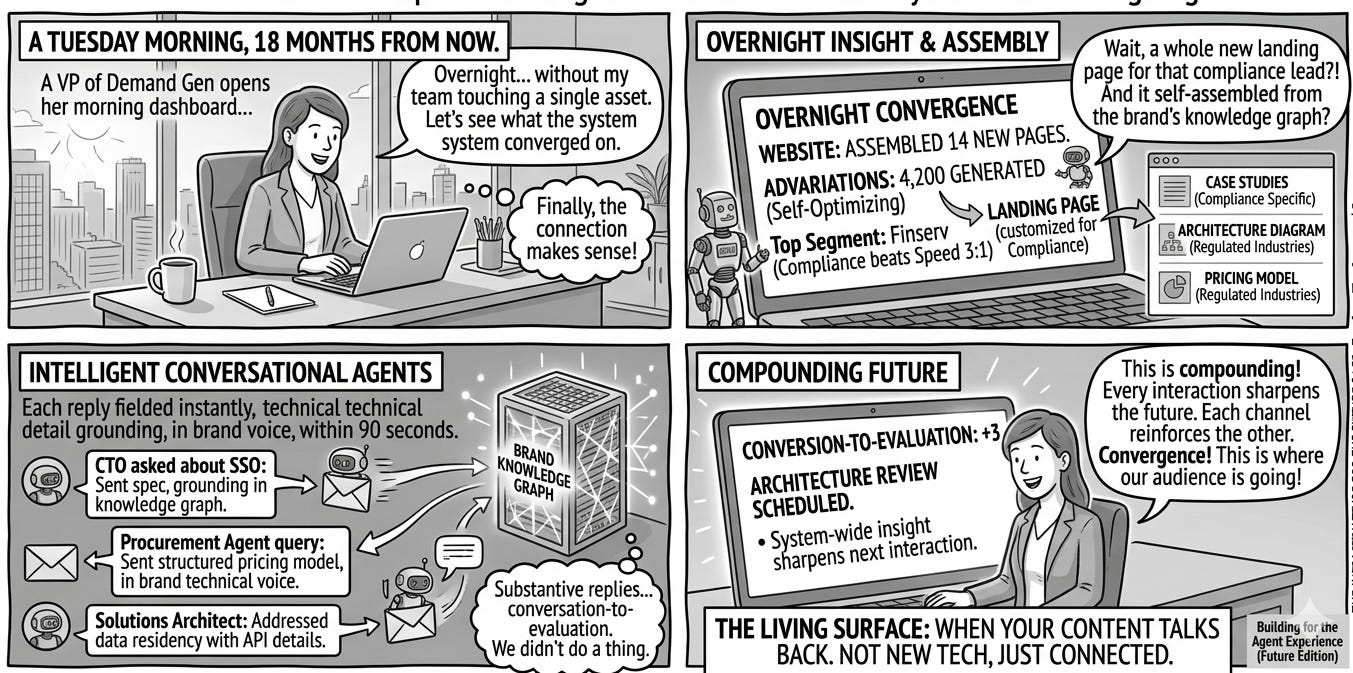
Picture a Tuesday morning, not far from now. A VP of Demand Gen at a large financial services enterprise opens her laptop. Overnight, three things happened without her team touching a single asset.
Her company’s website answered 340 visitor questions. One came from a compliance officer at a Fortune 500 prospect who typed, “We need a content platform that handles SEC disclosure requirements across 14 regional offices.” The page assembled itself in response: relevant case studies, a compliance-specific architecture diagram, a pricing model for regulated industries. The prospect spent 22 minutes on a page that didn’t exist before they arrived.
A product announcement email her team sent on Friday got 14 substantive replies. A CTO asked about SSO integration. A procurement lead wanted pricing for regulated industries. Each reply was fielded by an agent grounded in the brand’s knowledge graph, in brand voice, with accurate technical detail, within 90 seconds. Three of those conversations moved prospects from awareness to evaluation overnight. One scheduled an architecture review.
A campaign running across Google and Meta generated 4,200 unique ad variations overnight, each assembled from the brand’s knowledge graph. Different proof points for different industries, different product angles for different roles, different language for different regions. The system learned that compliance-focused messaging outperformed speed-focused messaging for finserv by 3:1, and that insight automatically reshaped the ads, the landing pages, and the email experiences for that segment.
Every piece of this is technically feasible today. The missing piece is the architecture that connects them.
Here’s what’s worth sitting with: this VP is not overwhelmed. She is not managing more. She spends her Tuesday morning shaping the brand’s point of view, deciding what the company believes about its market, teaching the system what good looks like. The assembly, the personalization, the cross-channel optimization: the system handles those. She does the work only a human can do: taste, judgment, conviction. The work most marketing leaders got into this career to do, and spend the least time actually doing.
That’s the shift this piece is about. Not smarter tools. A different relationship between the marketer and the content.
The break that’s already happened
For twenty years, marketing operated on a simple model: create content, place it in a channel, measure what happens. AI made the creation step 10x faster. Some organizations used that 10x to produce 10x more fixed assets: more landing page variants, more email templates, more ad creatives. Faster at the old model.
If you’ve felt the exhaustion of that approach, the treadmill of producing more assets that perform about the same, you’re feeling the structural break before you can name it.
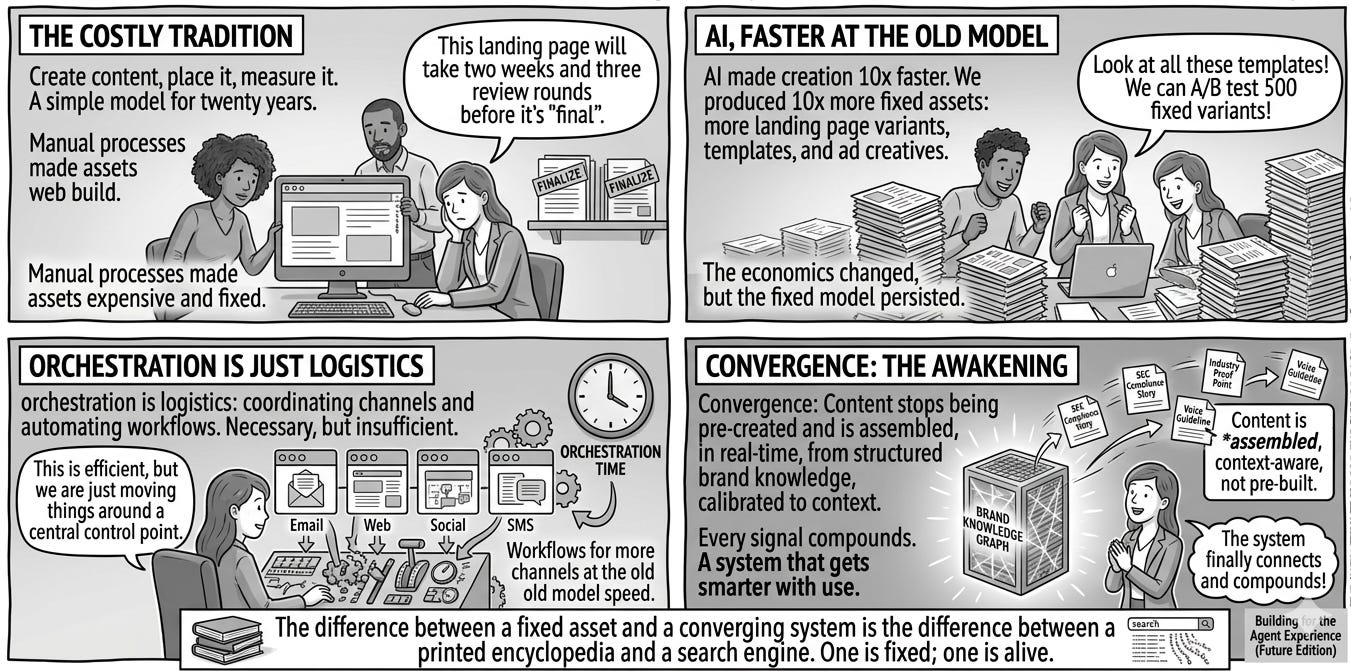
The economics that demanded fixed assets have evaporated. When a landing page took a design team two weeks and an email campaign required three rounds of review, you needed each asset finished before it shipped. Creation was expensive, so you batch-produced. That constraint is gone. The model has not caught up.
The industry calls the next step orchestration: coordinate more channels, automate more workflows, move faster. That’s necessary but insufficient. Orchestration is coordination without intelligence.
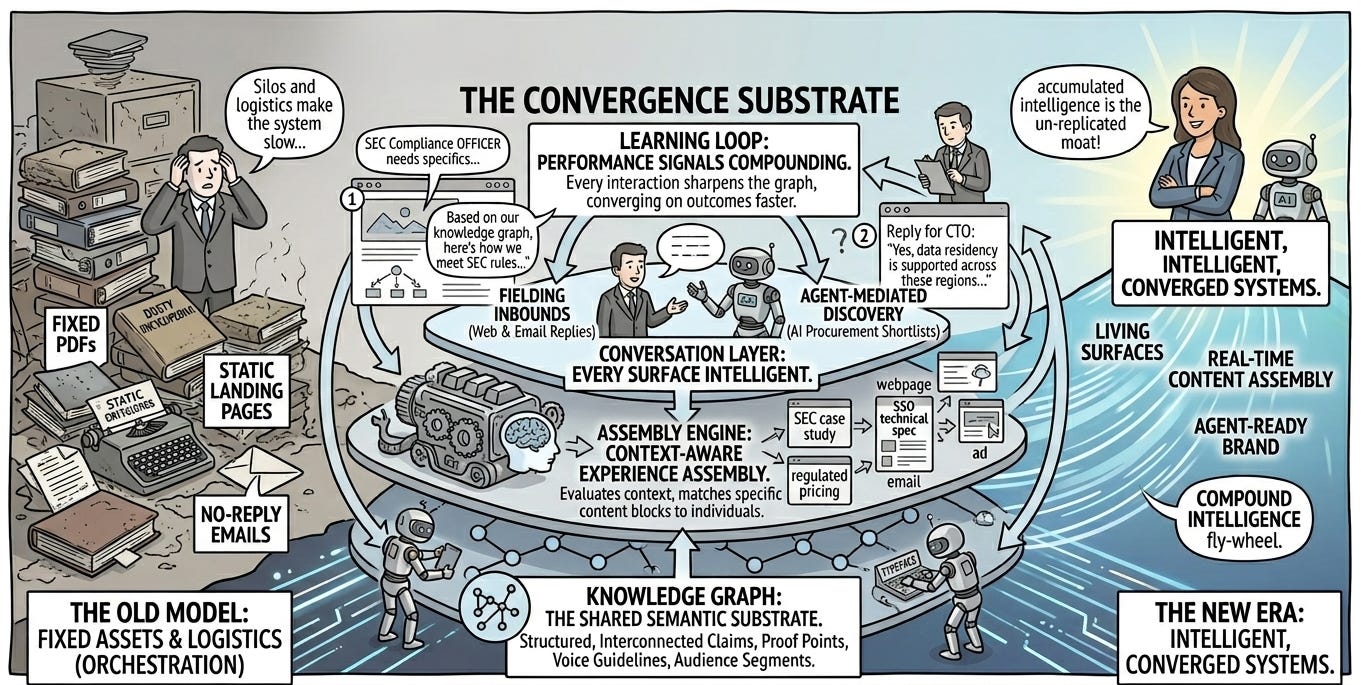
The real shift is convergence: every channel, every interaction, every signal compounds into a system that gets smarter with use and converges on the outcome faster than any single channel could alone. Content stops being something you create and becomes something the system assembles, in real time, from structured brand knowledge, calibrated to whoever is experiencing it and whatever context surrounds the moment.
The difference between a fixed asset and a converging system is the difference between a printed encyclopedia and a search engine. Both contain information. One is alive.
Three shifts that follow
These are connected, and each makes the others more powerful.
Every surface becomes conversational
Think about the last time you visited a B2B website with a real question. You scanned the navigation, clicked through three pages, opened a pricing PDF, and still couldn’t tell whether the product handled your specific compliance requirement. You filled out a “Contact Sales” form. Someone emailed you four days later with a link to a webinar.
A converging system doesn’t work like that. The same intelligence that assembled the page can answer questions about what it assembled. A visitor reading about your data platform asks, “Does this support HIPAA-compliant environments?” and gets a substantive, brand-approved answer inline.
This extends everywhere. An email assembled from a knowledge graph can respond when a recipient replies, because the agent behind the reply channel draws on the same graph that composed the message. Consider what “no-reply@company.com“ actually communicates: we sent you something, but we don’t want to hear back. It’s an artifact of a world where emails had no intelligence behind them. When the system that composed the email can also field replies, every outbound message becomes an inbound channel. The most natural response mechanism in digital communication, hitting reply, finally works.
And there’s a second-order effect. Your prospect’s inbox agent is already summarizing and prioritizing their messages. It encounters structured metadata in your email, parses the relevance, evaluates it against the recipient’s stated priorities, and surfaces a curated briefing. The question is no longer whether your email gets opened. It’s whether it survives triage by the recipient’s agent. Structured, substantive content survives. Broadcast blasts don’t.
Intelligence travels at system speed
This scene plays out every week. The paid media team discovers that a customer migration story drives twice the click-through rate of generic product messaging for healthcare prospects. That insight lives in a Google Ads dashboard. The email team nurturing the same segment won’t see it until someone mentions it in a Monday standup, if they mention it at all. The web team updating the healthcare landing page won’t hear about it for another sprint cycle.
Cross-channel intelligence, in most organizations, travels at the speed of meetings.
Convergence changes this because the channels share a substrate. When web pages, emails, and ads all assemble from the same knowledge graph, a proof point that converts in paid media automatically becomes a higher-priority building block for landing pages and emails targeting the same audience. The insight doesn’t travel through a meeting. It travels through the graph.
This creates the content-audience flywheel: content teaches about audiences, audience signals improve content, and the system compounds with use. Without the flywheel, AI content is a commodity, because whoever has the best model wins today and loses tomorrow when a better model ships. With the flywheel, every interaction creates data that improves the next interaction. That compounding is nearly impossible to replicate. It requires both the technology and the accumulated history of what worked, for whom, in what context.
The next buyer might not be human
A mid-market retailer is evaluating personalization platforms. Before a single human visits your website, their procurement team tasks an AI agent: “Find personalization platforms that support real-time product recommendations, integrate with Shopify Plus, handle GDPR across EU markets, and cost under $150K annually. Return structured comparisons.”
That agent doesn’t see banner ads. It doesn’t scroll a landing page. It queries structured data. If your brand isn’t structured for agent consumption, you’re invisible to this buyer. A human makes the final decision, but an agent makes the shortlist.
Industry estimates put machine identities between 45:1 and 80:1 versus human users in the average enterprise. When the majority of your brand’s interactions are machine-mediated, whether your content is structured, trustworthy, and queryable stops being a technical consideration. It becomes a distribution strategy.
This is Generative Engine Optimization, and it is becoming as consequential as SEO was in the 2000s. There is no “page 2” in an AI-generated answer. You’re in the response, or you don’t exist. A convergence architecture is inherently agent-ready: the same knowledge graph that assembles a landing page for a human visitor responds to a structured query from an agent with consistent, citable, brand-authorized answers. One substrate serves both audiences.
The architecture underneath
I work on these problems at Typeface, and the same architecture keeps showing up. Four layers, each load-bearing.
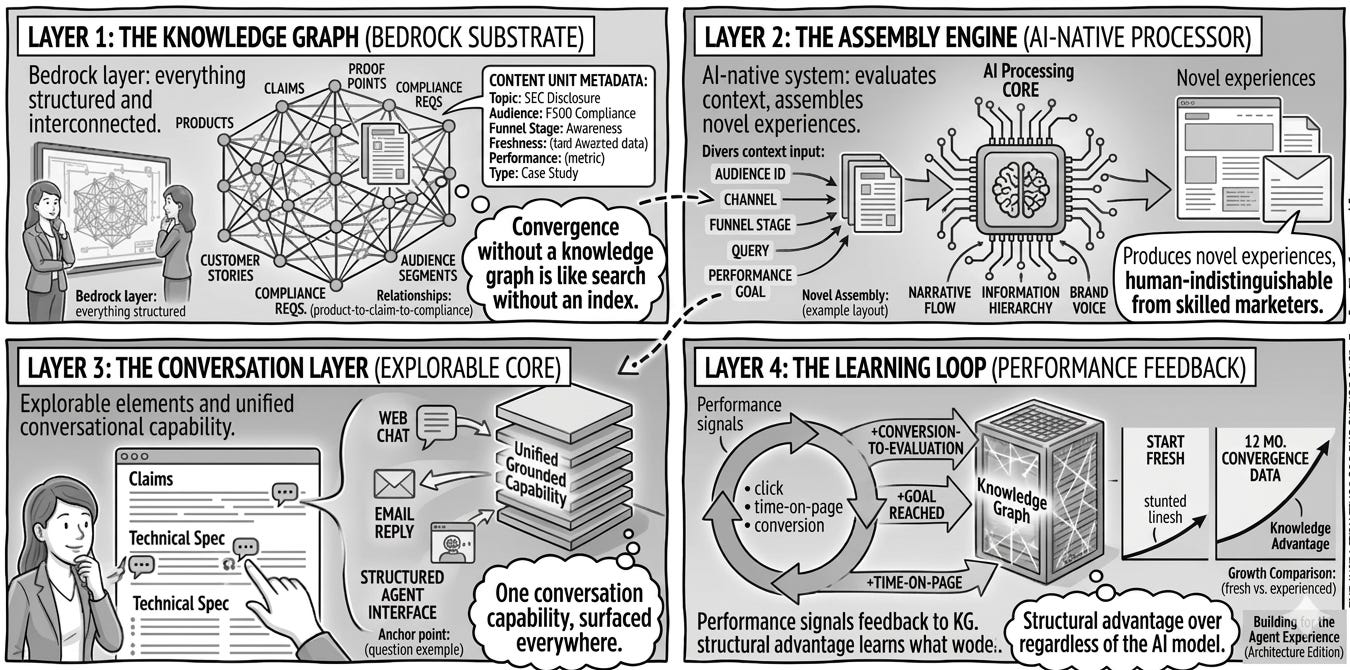
The knowledge graph. Everything the brand knows, structured and interconnected. Products, claims, proof points, customer stories, compliance requirements, voice guidelines, audience segments, and the relationships between all of them. Convergence without a knowledge graph is like search without an index.
The assembly engine. An AI-native system that evaluates context and assembles content blocks into coherent experiences. It understands narrative flow, information hierarchy, and brand voice. It produces experiences that have never existed in exactly this form, but that are indistinguishable from something a skilled marketer would create.
The conversation layer. Every assembled element can be questioned, explored, or expanded. The conversation is grounded in the same knowledge graph that produced the experience, so answers are substantive and brand-consistent. This same layer powers email replies and the structured agent interface. One conversation capability, surfaced everywhere.
The learning loop. Performance signals from every channel feed back into the knowledge graph. The graph learns which blocks work, for whom, in what combinations, on which channels. An organization with 12 months of convergence data has a structural advantage over one starting fresh, regardless of which AI model either uses.
These four layers become dramatically more powerful when connected to customer data in CDPs, journey tools, and CRMs. The CDP knows who’s arriving. The knowledge graph knows what the brand has to say. Connect them, and the compliance officer from the opening gets a page assembled for her role, her industry, and her specific evaluation criteria. The next morning, her email picks up where her page visit left off. The next compliance officer who arrives gets a better page than the last one, without anyone touching a template.
The early signs are in production
Websites that talk back. R/GA built alpha.g42.ai for G42, replacing traditional web navigation with a conversational AI called Marvin. The client brief, as Kyle Wheeler described it: “Websites are obsolete and agencies are interchangeable with close to no value added.” Pages don’t exist until someone asks for them.
Advertising goes headless. In April 2026, Meta shipped an MCP server for its entire advertising platform. Campaign data, product catalogs, conversion signals: all queryable by external AI agents. A platform that processes hundreds of billions in ad spend just made its core product machine-readable.
Content assembles into commerce. Expedia signed a year-long partnership with IShowSpeed and built infrastructure that collapses the distance between entertainment and transaction. TikTok clips feed directly into a custom microsite where viewers book the exact flights and hotels they just watched. They built this because 25% of Gen Z never visits an OTA at all.
Brand identity becomes machine-readable. Google’s Stitch team open-sourced DESIGN.md, a spec that makes brand rules parseable by agents. It earned 8,600 GitHub stars in fourteen days. The pattern is converging: CLAUDE.md for code agents, AGENTS.md for navigation, DESIGN.md for visual identity. Every domain is independently discovering that agents need structured specs, not examples.
None of these teams used the word convergence. They didn’t need to. They arrived at the same architecture because the same structural forces pushed them there.
What makes it hard
The sharpest objection is that most enterprises aren’t ready for this. The average marketing organization can’t maintain a clean CRM, let alone a structured knowledge graph. That’s real. But the graph doesn’t need to be complete to start compounding. An organization with 200 well-structured proof points already outperforms one with 10,000 unstructured PDFs. Convergence is directional. But the path has real obstacles.
Brand governance at convergence speed. A brand manager approves five ad variations for a campaign. The system generates 4,200 variations overnight. She cannot review them. Nobody can. Governance has to shift from approving individual assets to governing the building blocks and the assembly rules: the atoms are reviewed, the system is trusted to assemble them within constraints. This requires making subjective brand judgment programmatic. That is the hardest problem in the entire architecture.
Closing the measurement loop. Most organizations can’t attribute content performance to specific campaigns, let alone trace a conversion back to a specific proof point within an assembled page. Convergence-level measurement is a new discipline. The instrumentation infrastructure doesn’t exist at most companies.
The org chart. 48% of enterprise marketing leaders cite cultural resistance as a top-three obstacle to scaling AI (Typeface Signal Report, 2025). Convergence dissolves the boundary between “web team,” “email team,” and “paid team.” It replaces channel-specific playbooks with shared building blocks, shared governance, and shared metrics. It asks people who built careers as email specialists or paid media experts to see themselves differently.
That last point is worth dwelling on. If you’ve spent a decade becoming excellent at email marketing, the shift to convergence doesn’t just change your tools. It changes what your expertise means. The marketer who thrives in this world isn’t the best email specialist or the best paid media buyer. It’s the person who understands the brand deeply enough to teach a system what good looks like, and who can think across channels because the system already works across channels. That’s a different kind of career. For many, it’s a better one. But the transition asks something real of people.
The gap is already open
One path is to keep optimizing the model that got you here: produce more assets faster, run more A/B tests, hire more specialists per channel. AI makes this path incrementally better. It’s a reasonable choice for the next twelve months.
The other path is to rebuild around convergence: structure brand knowledge into a queryable graph, connect it to an assembly engine, make every surface conversational, close the loop between performance and creation. This path is harder.
The gap between these two paths widens with time. Every interaction on the convergence path teaches the system something: which proof point converted, which audience responded, which combination outperformed the template. Every campaign on the asset path resets to zero. After a year, the difference isn’t speed. It’s accumulated intelligence, and there is no shortcut to catching up on what someone else’s system has already learned.
You’ll know it’s happening when your competitor’s landing page answers a question yours can’t. When their email gets a reply and yours gets archived. When an agent recommends them and doesn’t mention you.
The generation problem is solved. The convergence problem is the next decade. And the early signs aren’t on a roadmap. They’re already in production.