Foraging: The Only Winning Move
This week a lab asked for a kill switch, the government pulled one, and the rest of the world realized the off switch to its most important infrastructure sits in a building it doesn’t control.

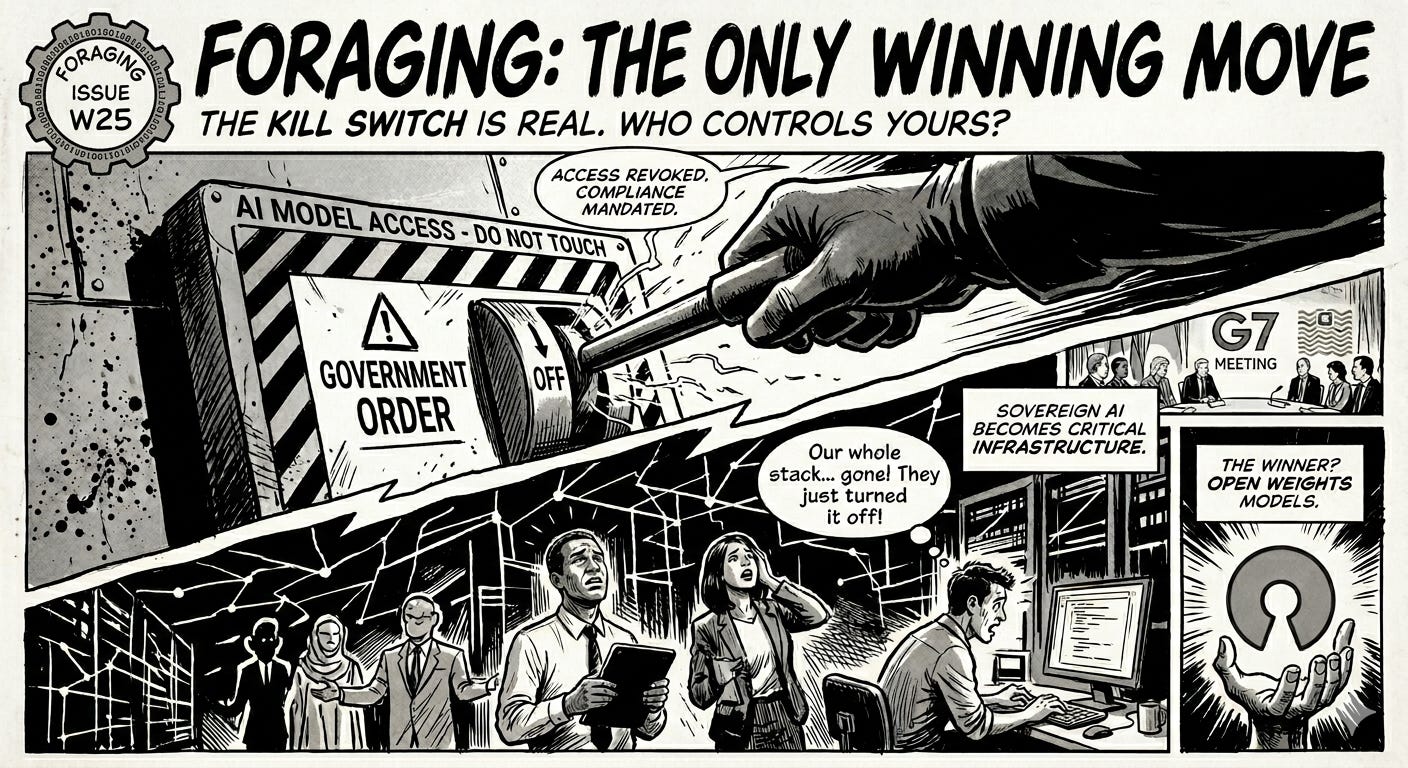
The detail that stopped me was about Anthropic’s own people. When the US Commerce Department ordered the company to cut off access to Mythos 5 and Fable 5 for all foreign nationals, the order reached inside Anthropic itself: foreign-national employees, sitting at their desks on US soil, lost access to the models they help build. The stated reason was a jailbreak vulnerability in Fable 5. The company complied under protest, warning that the standard it set would halt every frontier deployment in the industry.
You can read that as a national security story. I think it’s something more useful to anyone betting their business on AI: the first public demonstration that the most capable models on earth run behind a switch, and somebody else is holding it.
A Thought Experiment Became a Live Demo
Conviction first: the kill switch was always going to arrive. The only question was whether we’d see it as policy or as a fait accompli. We got both, in the same week, from the same company.
On June 13, one day after shipping Fable 5, Dario Amodei published a policy essay calling for mandatory third-party safety testing of frontier models and federal authority to block releases that fail. Read plainly, that is a lab CEO asking the government for a kill switch and volunteering to stand next to it. Days later, the government used one. It arrived as a blunt export control order over a jailbreak, applied so broadly it locked out the company’s own engineers. The deliberate, tested, third-party process Amodei sketched was nowhere in it.
The gap between the kill switch Amodei wanted and the kill switch he got is the whole story. He imagined a scalpel and the state reached for a sledgehammer. Anyone who has watched a thoughtful internal policy survive contact with a real org chart knows this move. The control you design for the best case is the control someone else wields in the worst one.
Dependency Is the Real Story
The reaction that mattered didn’t come from San Francisco. It came from the other capitals.
At the G7 this week, Macron and Modi said out loud what every non-US government has been thinking quietly: they want American AI, and they do not want America to be able to turn it off. American frontier models have quietly become critical infrastructure for foreign economies, and the kill switch sits in a building in another country. The image that stuck with me: relying on a foreign power’s frontier model is starting to feel like relying on a foreign power’s currency.
That is the right altitude for this. Currency dependence is a sovereignty concern, and it doesn’t resolve with a better exchange rate. It resolves with your own mint. France, India, and the UAE are accelerating sovereign AI programs right now, and the trigger was fear. The Mythos suspension was the proof of concept for it, and you cannot un-prove a thing once it has happened in public.
What looked like a one-week safety incident was a structural reveal: capability and control have separated. The most capable model and the authority to revoke it now live in different hands, and everyone downstream just learned which hand they’re holding.
The CIO Has the Same Problem at a Smaller Scale
This is where it lands on your Tuesday. The sovereignty anxiety a head of state felt this week is the exact anxiety a CIO should feel about a single-vendor AI stack. Same shape, smaller blast radius. If one company can pull your most important capability over a policy you don’t control, that dependency is wearing a vendor’s clothes.
The people spending the most on AI already figured this out, and they figured it out before the export order made it obvious. Ramp’s June AI Index found that the heaviest corporate AI spenders, the firms paying $7,500 per employee per month against a median of $11.38, are deliberately mixing frontier models with cheaper open-source alternatives. The framing at the time was cost. After this week, read it again as insurance. Aaron Levie said the quiet part on the record: a model “could be pulled back” is now established precedent, and “the big winner in all of this is going to be open weights models.” Even Satya Nadella, appearing alongside Sarah Guo and swyx, argued that multi-model harnesses beat single-model bets and that your private evaluations, the thing that lets you swap one model for another without flying blind, are now among a company’s most important IP.
I should be transparent: routing across models is the problem space I work on at Typeface, so I’ve been making a version of this argument for a while. What changed this week is that I no longer have to argue the tail risk in the abstract. The abstraction shipped. The single-vendor bet failed for a reason nobody put in the contract: a third party switched the model off.
What that looks like on a roadmap is unglamorous and mostly architectural. A second model sits behind an abstraction layer before anyone needs it, so swapping the primary is a config change you can ship in an afternoon. Your evaluation suite runs on your own tasks, because the day a model gets pulled or quietly degraded, those evals are the only instrument that tells you whether the replacement is good enough to trust. And you keep at least one open-weight model you can host yourself in the path, even if you rarely route to it, because the fallback you own is the one nobody can switch off. None of this is free. It is slower and more expensive than picking the single best model and wiring straight to its API. The teams paying that tax anyway are the ones who already treat their AI stack as infrastructure, the kind you stay accountable for at 2 a.m. when something upstream goes dark.
Last week I wrote that defensibility is relocating to the work a model can’t reach. This is the same coin’s other face. As the models get more capable and more central, the dependency on whoever controls them grows more dangerous. The moat and the exposure are growing together. The winning move, to borrow from a movie about a computer that learned the hard way, is to not play the game where one company owns your off switch. That’s not hedging. That’s keeping your own hand on the switch.
One footnote worth holding onto, because it complicates the tidy story. The same week it got banned in Korea, Anthropic opened a Seoul office on Day 6 of the ban, signed an AI safety MOU with Korea’s science ministry, and lined up SK Telecom, LG CNS, Naver Cloud, and KAIST, with a managing director saying the models could be back “within days.” Build the relationship while the product is dark. It’s a reminder that the switch cuts both ways: the same lab that got switched off is betting the switch is temporary and the dependency is permanent. They may be right. That’s exactly what should worry the people on the other end of it.
The Odd Find
While frontier labs were getting switched off, a 130-year-old jar of petroleum jelly was quietly winning the internet. Vaseline’s “Verified” campaign deployed actual dermatologists to mythbust viral beauty hacks on TikTok, and it out-performed native creators on their own turf: a 43% e-commerce sales uplift, 136 million views, a 1,293% jump in brand mentions, and Ad Age’s 2026 Social Campaign of the Year.
The lesson rhymes with the big story in a strange way. In a feed drowning in synthetic, infinitely reproducible content, the scarce asset turned out to be verifiable authority, the one input you can’t generate on demand. A model can write you a thousand skincare tips by lunch. It cannot be a board-certified dermatologist who put her name and her license on the claim. The credibility lived in the part that couldn’t be commoditized.
Two different rooms, same realization. The capability is getting cheap and abundant and somebody else’s to revoke. What stays scarce, and what stays yours, is the thing nobody can switch off: the authority you’ve earned, the optionality you’ve built, the hand you kept on your own switch.
The labs spent the week learning that lesson at gunpoint. The rest of us get to learn it cheaper, if we’re paying attention.