Foraging: Mille-Feuille
Five companies shipped the same enterprise-AI architecture this month. The question worth arguing is no longer whether the shape is right, but who gets to own each layer of it.

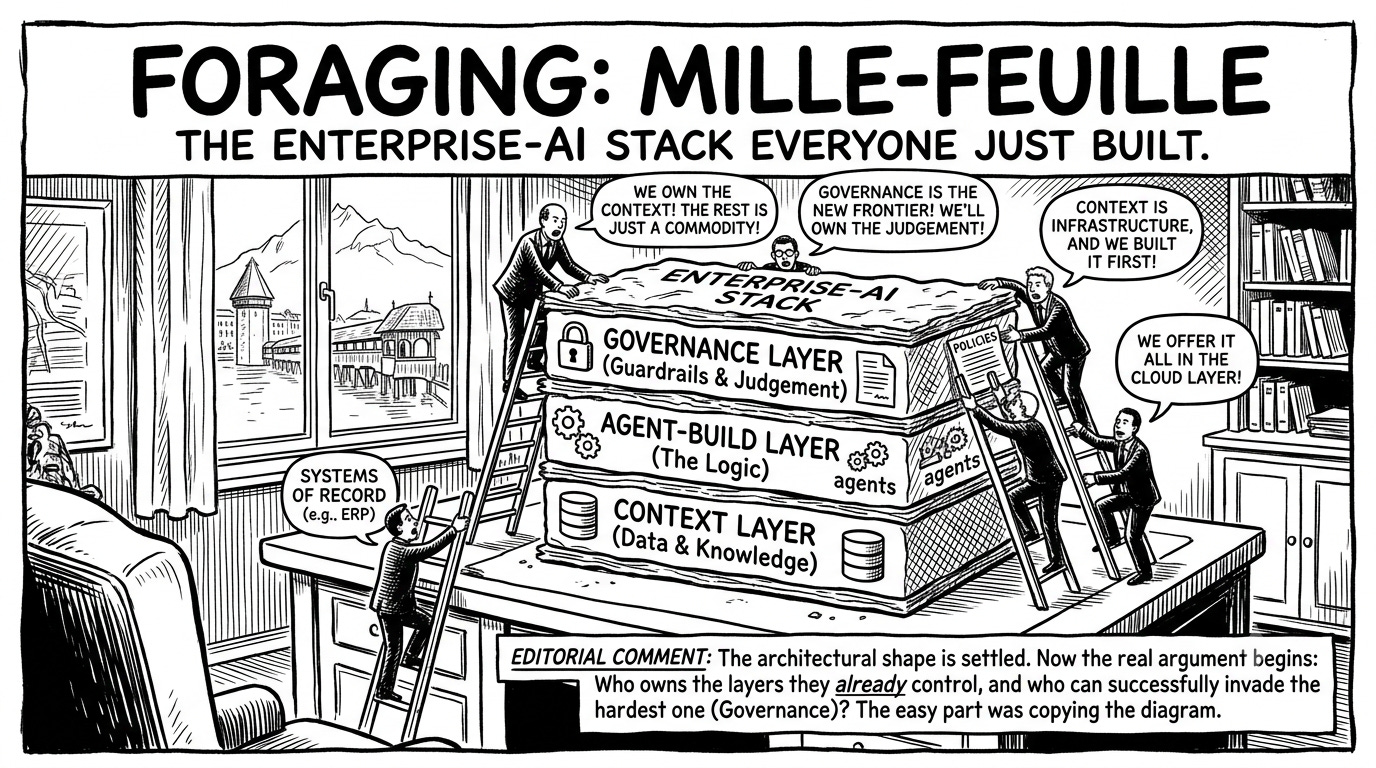
I just got back from two weeks in Switzerland, which is the honest reason there was no edition. One afternoon in Lucerne we stopped for lunch on the old-town square at a place called Mill’Feuille, named, I assume, for the pastry and its hundred paper-thin layers. I thought nothing of it beyond a good pun. Then I came home to a week of enterprise AI announcements that were, as it turned out, all about layers. Too neat to ignore.
Within a few days of each other in July, five launches landed from unrelated corners of the market: an infrastructure startup, two enterprise-software giants, a frontier lab, and a cloud platform. Different companies, different logos, and underneath each one the same three boxes stacked in the same order: a layer that structures a company’s context, a layer where you build agents against that context, and a layer that governs what those agents are allowed to do. I build this layer for a living, so I tend to read launch posts the way a bricklayer reads a wall. Underneath the familiar enthusiasm for agents, something quieter was going on. The argument about how to build them is settling on one answer.
The Shape Settles
For two years the interesting question in enterprise AI was architectural. Where does the intelligence live. How much of a company’s knowledge do you pre-structure versus retrieve on the fly. Who holds the guardrails, and how tight are they. Reasonable people disagreed, and the disagreement was the whole game. This month a handful of companies answered it the same way, from starting positions that have almost nothing in common.
Pinecone shipped Nexus, a “knowledge engine for agents” that pre-structures scattered enterprise documents into a queryable layer so agents stop re-retrieving raw files on every call. Their own line is the sharpest statement of the thesis I have seen from a vendor: better models will not save your agent. The savings they cite are real enough to matter, roughly seven times fewer tokens than a standard retrieval setup on their own benchmark, and far fewer than a coding agent left to fetch files on its own. Read past the product copy and the argument is that context is infrastructure, and you build it once.
A day later SAP drew the same picture from the opposite corner of the market. Its Business AI Platform collapses a sprawling stack into three layers: a semantic layer that fuses SAP and non-SAP data into something an agent can reason across, a build layer that turns a stated business outcome into an agent, and a governance layer that discovers every agent and polices what data each one can touch. Pre-structure the context, build against it, govern from one place. Pinecone reached up from infrastructure. SAP reached out from the system of record. They met at the same diagram.
Then the pattern stopped being a coincidence between two companies. Oracle opened its Fusion agents to pro-code developers with the same context-plus-governance spine. OpenAI, a company that until recently sold tokens, introduced Presence, a platform for enterprise voice and chat agents built around approved actions, escalation to a human, pre-production testing, and graded evaluations. Its vocabulary is the tell. A lab that used to talk about capability now talks about what an agent is permitted to do. And Alibaba Cloud presented an agent-native cloud on the same logic, which means the shape has left the American enterprise and gone global.
The sameness is the signal. The same three moves keep showing up: structure the context, build agents against it, govern the result. When an infrastructure vendor, two systems of record, a model lab, and a hyperscaler all land there independently, the shape has hardened into a floor the rest of the stack now builds on. I find this validating, because it’s the argument I made back in March: that this whole category was becoming a content operating system. It’s a strange feeling to watch a thesis get drawn by five other hands in a month. It also comes with a warning, which is the part I want to spend the rest of this on.
Who Owns Which Layer
Agreeing on the shape settles nothing about who gets paid for it. That is the fight actually underway, and it is more interesting than the architecture, because everyone is defending the layer they already own while reaching for the one above it.
Pinecone owns retrieval, so it is reaching up to own the context layer before a model lab or a database does. SAP and Oracle own the process data, the purchase orders and the ledgers and the workflows, so they claim the context layer by default and dare you to rebuild it somewhere else. OpenAI owns the model, and Presence is the sound of a model company deciding that the model is not where the durable money is, so it is climbing into operations and governance while it still has the attention. Each move is rational. Each is also a bid to make the layer below you a commodity and the layer you are moving into the thing customers pay for.
This is where I should be transparent that I work in this space. I am President of R&D at Typeface, and we come at the same stack from the content and quality side, which is to say I have skin in exactly the argument I am describing. So take the next sentence with that disclosure attached. The layer you already own decides which layer you can credibly claim, and no amount of ambition changes that. A model lab can build a governance product, but it can’t manufacture ten years of a customer’s process data. An ERP can wire agents to its own ledgers, but it cannot easily become the neutral context layer for the half of a company’s knowledge that never lived in SAP. The convergence made the diagram common. It left the layers underneath wildly unequal in how defensible they are.
The Layer That Stays Hard
A settled shape is comforting and a little misleading. It suggests the hard part is behind us, when most of the hard part is still ahead. The context and build layers are becoming the baseline at the speed you would expect once five companies are copying each other. The layer that stays hard is the last one, governance and evaluation, and it stays hard for a reason that has nothing to do with engineering.
Structuring context is a data problem, and data problems yield to effort. Judging whether an agent did the right thing is a different kind of problem, and judgment doesn’t pre-structure or retrieve. You can’t compile taste into KnowQL. This is why every one of these launches spends its confident paragraphs on the context layer and its careful, hedged paragraphs on the governance layer, full of words like policies and guardrails and human-in-the-loop. Those words are doing a lot of work, and the work is unfinished. The part of the stack that is easiest to draw is the part that is hardest to actually run, and it is also the part least likely to commoditize, because it is the part a bigger model does not solve.
So the diagram everyone agreed on this month is mostly agreement about the easy layers. The layer worth owning is the one nobody has finished, and the companies that understand that know better than to celebrate the convergence. They are racing to make the top layer real.
The Odd Find
Audi found a way to make a spec sheet tremble. Its RS 5 launch this month, a campaign from BBH London called “RS 5 Shake”, recorded the car’s real engine sound and the torque data from a high-performance run at Neuberg, then fed that data into the launch photography. The type trembles, the frames shift, and the images blur and distort, carrying the force of the car’s 639 horsepower. Even in print, where nothing can move, the work leaves the impression of a page still vibrating. Most people have no idea what 639 horsepower feels like in the chest, and a spec sheet is boring, so Audi made the picture behave as if the force were shaking it. Call it “show, don’t tell” taken about as literally as it goes.
A mille-feuille is mostly layers anyone can make. It holds together because of the thin cream between them, the part nobody photographs. This stack is the same. The architecture is settled, and who gets paid for it is the open question. They all drew the same diagram this month, and that was the easy part. The next year belongs to whoever can own the one layer a better model doesn’t make free.