Foraging: Life Moves Pretty Fast
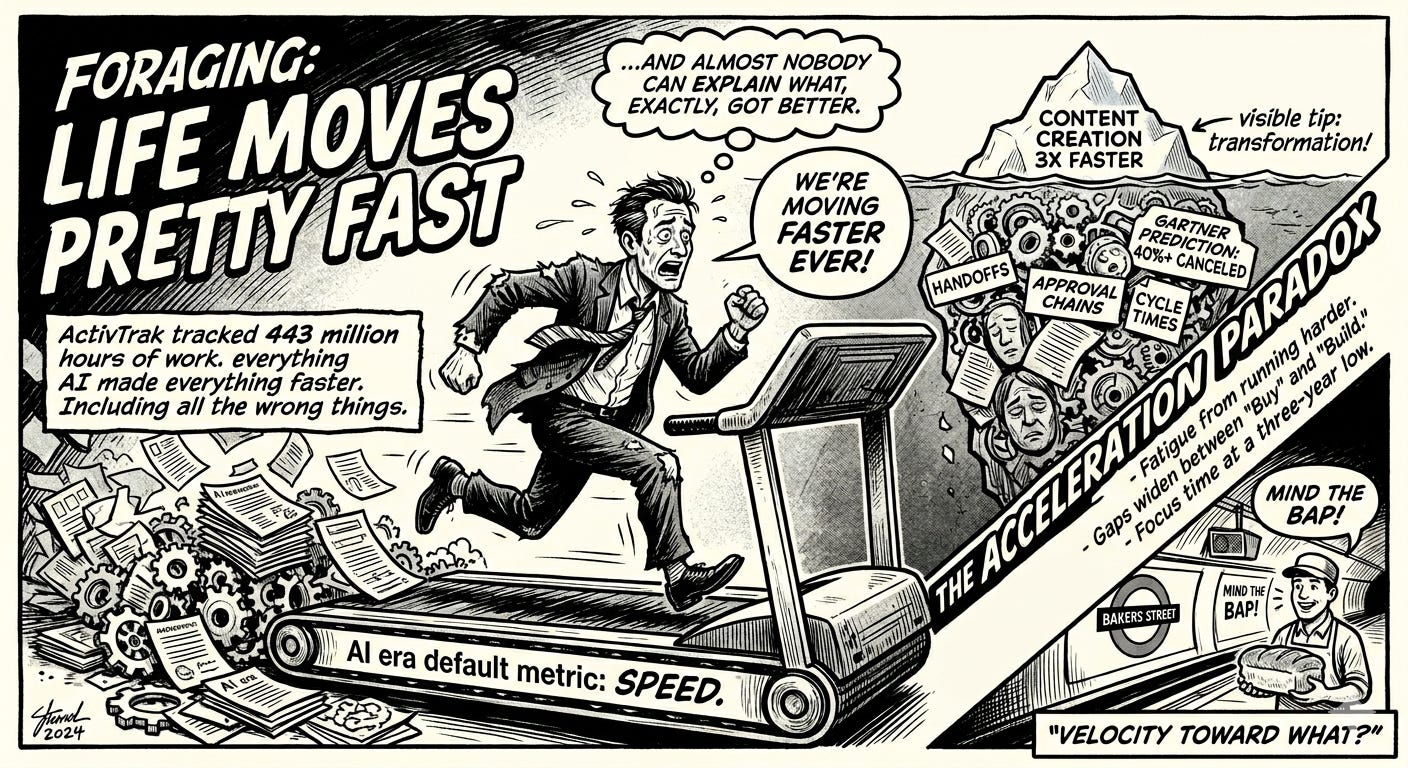
ActivTrak tracked 443 million hours of work. AI made everything faster. Including all the wrong things.

Foraging: Life Moves Pretty Fast
ActivTrak tracked 443 million hours of work. AI made everything faster. Including all the wrong things.
Something shifted in the conversations I’ve been having this month. Every leader says the same thing: we’re moving faster than ever. The dashboards confirm it. And almost nobody can explain what, exactly, got better.
I think speed became the default metric for the AI era. And I think it’s exactly the wrong one.
The Acceleration Paradox
There is a specific kind of fatigue that comes from running harder without gaining ground. It has a shape, and the data is starting to trace it.
The pattern I see in almost every marketing org I talk to: the content team is 3x faster. The approval chain takes just as long. The campaign cycle hasn’t budged. Individual speed went through the roof. Organizational speed barely moved.
Alexander Atzberger calls this the iceberg problem. The tip is visible: content that took days now takes minutes. Below the waterline, handoffs and cycle times are unchanged. Gartner predicts 40%+ of agentic AI projects will be canceled by end of 2027, largely because organizations solve the tip and call it transformation.
Microsoft’s Work Trend Index surveyed 20,000 workers and found something that should worry anyone betting on tools alone: organizational factors drive 2x greater AI impact than individual skill. The report maps a progression from using AI for individual tasks to restructuring entire workflows around it. Most companies haven’t made it past the first step. The tools outpaced the org charts.
The fracture is now visible at the top. A Workplace Intelligence study of 2,400 knowledge workers found 54% of C-suite say AI is “tearing their company apart.” 75% admit their strategy is “more for show.” Nearly all of them, 97%, have deployed AI agents in the past year. And 60% are planning layoffs for employees who don’t adopt.
The message is clarifying: move faster, or move out. But when 79% of those same organizations report challenges in making AI work, the speed demand starts to look like a different kind of dysfunction. These are companies running at two speeds, with leadership measuring one and experiencing the other.
Aditya Agarwal, who scaled engineering at Facebook and served as CTO of Dropbox, named the deeper risk: good speed compresses learning cycles, bad speed optimizes for novelty over depth. AI makes novelty trivially easy. The edge is choosing what is worth building and staying long enough to learn something the market doesn’t know yet. Lower friction can also mean accelerating false starts.
If you’re a marketing leader reading this, ask yourself: is your team faster at the things that compound, or faster at the things that expire?
Where the Work Piled Up
Speed up one part of any system and you expose the next constraint. Every engineer knows this intuitively. Most organizations are learning it the hard way.
The clearest example is code review. AI-assisted engineering teams merge 98% more pull requests, according to a Faros AI analysis. And code review time increased 91%. Developers report higher productivity and more time spent reviewing other people’s code. Judgment became the bottleneck.
This is Amdahl’s Law at organizational scale. The principle is simple: the overall speed of a system is limited by the part you can’t parallelize. You parallelized the writing. You exposed the understanding. The review layer, the part that decides whether the code is correct and architecturally sound, doesn’t compress the same way. The humans doing the reviewing are the fixed-speed stage.
A survey of 900+ engineers by the Pragmatic Engineer confirms the practitioner experience: “shippers,” the engineers who benefit most from AI, also accumulate tech debt faster. They write more, commit more, and leave more for the next person to untangle. Engineering managers and individual contributors are converging on the same work, because when AI writes the code, the remaining work is judgment and review. Companies spend $100-200 per month per engineer on AI tools. Nobody has figured out how to fund the review capacity those tools create.
And the spending is running ahead of the strategy. Ramp’s May 2026 AI Index shows Anthropic passing OpenAI in business adoption for the first time: 34.4% vs. 32.3%. Anthropic quadrupled year-over-year while OpenAI grew 0.3%. Companies are buying faster than they can absorb. Separately, Uber reportedly burned through its entire 2026 AI budget by mid-year. If a company with that engineering bench and that operational discipline can’t manage AI spend, the rest of the market should pay attention.
When Fast Stops Being a Moat
The bottleneck migration in engineering is a preview of something larger. When AI compresses the building, what happens to the people whose advantage was building faster?
Two enterprise deals died the same way, as Gokul Rajaram documented in late April. Buyers chose to build internally rather than renew. Above $500K in annual contract value, a domain expert with Claude Code can replicate a functional workflow tool in weeks. It won’t have the polish. It won’t scale the same. But “good enough” is all procurement needs when the alternative is writing another six-figure check. The vendor’s speed advantage, the thing that justified the contract, evaporated.
This is the acceleration paradox applied to markets. SaaS companies built moats on being faster than their customers. AI collapsed that gap. The gap between “buy” and “build” that was months or years is now weeks. Enterprise teams carry AI transformation mandates on 2026 OKRs. Replacing a vendor with an internal build is a two-for-one: kill the budget line and claim the AI transformation win. The switching cost isn’t worth the hassle at $50K. At $500K+, the VP has a self-writing business case. The vendor’s moat didn’t leak. It was never as deep as the contract implied.
So if speed isn’t a moat for the individual worker, isn’t a moat for the engineering team, and isn’t a moat for the software company, what is?
Dan Rosenthal offers an answer. He scaled from 2 to 20 people in 9 months by dogfooding a closed-loop go-to-market system: Clay, HubSpot, and AI agents forming a seven-step pipeline where step 7’s performance data refines step 1’s targeting. Every outbound sequence teaches the next one. Every reply rate adjusts the next round of personalization. The system compounds because each cycle sharpens what comes after. It didn’t start fast. It got fast by staying in the loop long enough to learn.
That is a different kind of fast. Not faster at executing. Faster at learning. Rosenthal’s system compounds because every output feeds back into the inputs. Atzberger calls this “multi-player AI”: what one person discovers becomes available to everyone. Microsoft’s research describes the same pattern at enterprise scale, where human oversight narrows to the decisions that matter and agents handle the rest. The design is what creates the speed.
The organizations that treat AI as an accelerant for the existing model end up producing more of everything and improving nothing: more email, more chat, more weekend hours, same outcomes. ActivTrak’s data is the proof. The ones that redesign the model, that ask which work should exist at all, end up with systems that compound. And compounding is a property of design.
The Odd Find
Meanwhile, in a corner of the internet unrelated to AI productivity: Warburtons, a 150-year-old British bakery, convinced Transport for London to rename Baker Street station to “Bakers Street” for two days. They replaced platform announcements with “mind the bap” and “stand behind the buttery yellow line.” A bread company hijacked the London Underground. No algorithm, no agent, no dashboard. Just a good joke and whatever internal approval chain greenlit “mind the bap.” Sometimes the fastest path to attention is not speed at all.
If you’re in a room this week where everyone is celebrating velocity, it might be worth asking the follow-up: velocity toward what?